1. Introduction
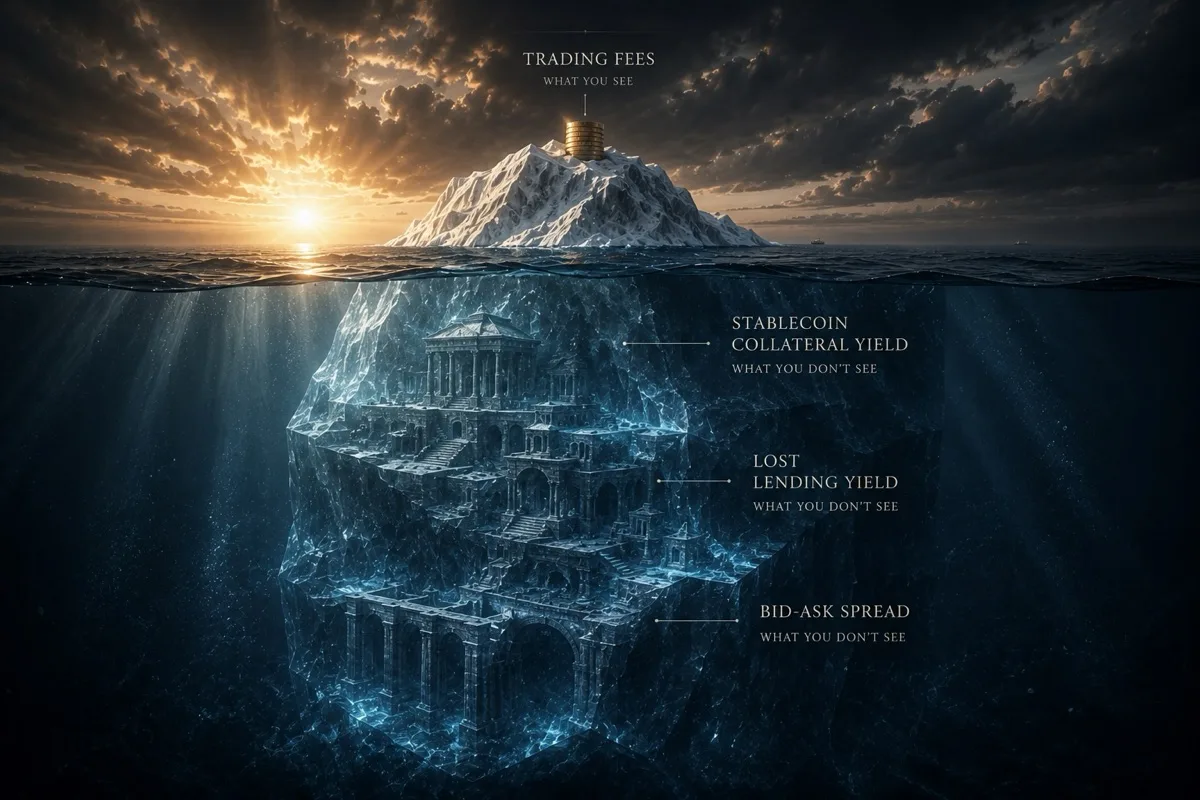
Capital efficiency is the umbrella term for "how hard an exchange lets your capital work". Two exchanges with identical prices and fees can still differ by up to 20% in annual return, purely through how efficiently your balance can be deployed.
On this site we include this factor in our cost comparison. On this page we explain which elements determine capital efficiency.
2. What exactly is capital efficiency?
Capital efficiency is the degree to which your total capital is deployed to generate return, rather than "sleeping" on the exchange. On traditional exchanges, a large share of your balance often sits idle: cash in your account, or collateral locked one-to-one against a single trade.
Modern crypto exchanges design their architecture so that every asset in your account serves several functions at once: as collateral, as a yielding balance and sometimes as a tradeable position. Over the longer term this makes a substantial difference in return.
Continue reading the article
3. The four key factors
- Yield on unused collateral. Do you earn interest on cash that is not tied up in trades?
- Cross collateral / multi-asset margin. Can you use multiple assets as collateral at the same time?
- Portfolio margin. Is your risk calculated per portfolio or per trade?
- Unified wallet. Can one balance do everything: spot, perps, stocks, lending?
4. Yield on unused collateral
Most crypto exchanges pay no interest on your USD/USDC balance. More innovative platforms offer 3-5% APY on your cash collateral — without having to lend, stake or take on other risks.
See Yield on collateral explained for a detailed comparison.
5. Cross collateral and multi-asset margin
See Cross collateral explained.
The big advantage: you do not have to sell crypto in order to trade. This saves conversion costs and avoids taxable events in many jurisdictions.
6. Portfolio margin and risk offsets
Portfolio margin is an advanced margin system that assesses the total risk of your portfolio, instead of each position individually. Opposing positions (e.g. long BTC spot + short BTC perpetual) can lower your margin requirement.
Example:
- Long 1 BTC spot: no margin needed, you own it
- Short 1 BTC perp: normally 10% margin (~€6,000 at BTC €60,000)
With portfolio margin, the exchange sees that these positions hedge each other. The margin requirement can then drop to, for example, €600.
7. A unified wallet (spot, perps, stocks)
On most exchanges you have a separate wallet per product type. That leads to idle balances: money that is not deployed because it sits in the "wrong" wallet.
A unified wallet keeps everything together. Your USDC simultaneously backs your BTC perp, your Tesla share and your crypto lending. Whatever is left over can automatically join the cash lending program.
8. How do you calculate capital efficiency?
A simple formula:
Effective return = Trading return + Yield on idle balance − Conversion/rebalancing costs
Suppose you have €100,000 in your account. On a traditional exchange, 30% sits idle. On an efficient platform, everything works in yield or trades.
- Traditional: €70,000 works, €30,000 idle. Extra return: 0%.
- Efficient: €100,000 works (€70,000 in trades, €30,000 yielding at 4%). Extra return: €1,200/year.
Over 5 years that adds up to a difference of €6,000+ on the same deposit.
Capital efficiency determines how much of your balance actually generates return instead of sitting idle on the exchange. At identical fees, that can add up to around 20% more return per year, through yield on collateral, cross collateral and portfolio margin. The effect is largest with larger balances and multiple simultaneous positions.
Frequently asked questions
Is capital efficiency only for large traders?
No. Even on €10,000-€50,000 accounts it makes a difference, especially if you hold several positions at the same time.
What is the risk?
Cross collateral and portfolio margin can lead to bigger hits when a position loses sharply. Know what you are doing and use risk limits.
What exactly is a unified wallet?
A wallet that combines spot, perpetuals, stocks and lending.