1. Introduction
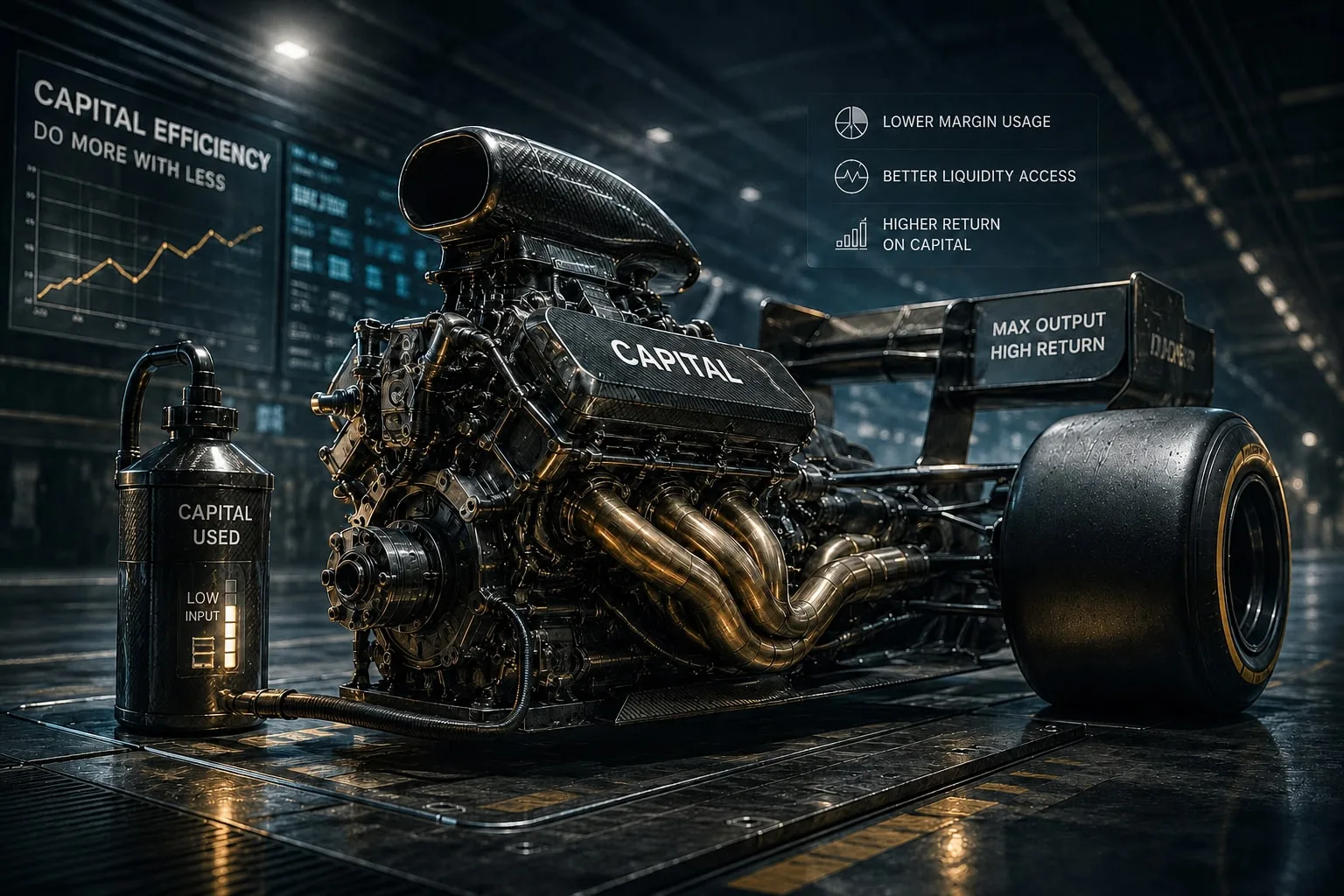
Many perpetual futures settle in USDC or another dollar currency. Without multi-asset collateral, you must hold settlement collateral first. Cross collateral allows supported assets such as BTC, ETH and SOL to count as margin instead. The assets remain in exchange custody and keep their economic price exposure; this is not self-custody.
If most of your portfolio is held in Bitcoin or Ethereum, a single-collateral setup can leave much of that capital unavailable for trading unless you sell or convert it first.
Related reading: capital efficiency, yield on collateral and true cost of trading.
2. What is cross collateral?
Cross collateral is a margin system in which the risk-adjusted value of multiple assets forms one shared collateral pool. The exchange does not need to sell your BTC when you open a position: it calculates a collateral value and uses that value to support positions and borrowing.
Without cross collateral, a portfolio with €40,000 in BTC and €10,000 in USDC may provide only €10,000 of direct margin. At a 95% BTC weight, the same portfolio can contribute about €48,000.
Read the full analysis ⌄
3. How does it work?
Each supported asset receives a collateral weight. A weight of 1.00 means 100% counts; 0.95 means 95% counts and therefore a 5% haircut. Collateral value equals quantity × mark price × collateral weight. Weights may fall for large concentrations because liquidation would create more market impact.
- Weight 1.00: 100% counts; haircut 0%.
- Weight 0.95: 95% counts; haircut 5%.
- Weight 0.70: 70% counts; haircut 30%.
Collateral value = quantity × mark price × collateral weight.
Weights can be size-dependent. A large concentration may receive a lower marginal weight because liquidation would create more market impact.
4. Example: €90,000 becomes €88,500
| Asset | Value | Weight | Counts |
|---|---|---|---|
| USDC | €50,000 | 1.00 | €50,000 |
| USD | €10,000 | 1.00 | €10,000 |
| BTC | €10,000 | 0.95 | €9,500 |
| ETH | €10,000 | 0.95 | €9,500 |
| SOL | €10,000 | 0.95 | €9,500 |
| Total | €90,000 | — | €88,500 |
With €50,000 USDC, €10,000 USD and €10,000 each in BTC, ETH and SOL, the first €60,000 counts at 100% and the crypto at a 0.95 weight. Total collateral value is €88,500. The missing €1,500 is a risk buffer, not a fee.
The €1,500 that does not count is a risk buffer, not a fee. Without cross collateral, only the €60,000 in USD and USDC would be directly usable in this example.
5. Which assets count?
Backpack parameters checked through the official collateral API on 25 July 2026 are shown below. These are base weights and may decrease for larger balances.
| Category | Assets | Base weight |
|---|---|---|
| Stablecoin | USDC | 1.00 |
| Large crypto | BTC, ETH, SOL, USDT | 0.95 |
| Mid-caps / gold | XRP, PAXG | 0.80 |
| Other | SUI | 0.75 |
| Other | DOGE, HYPE, SEI, APT, BNB | 0.70 |
| Other | ZEC | 0.60 |
| New tokens | XPL, MON | 0.50 |
| Highest risk | JUP | 0.25 |
Sources: Backpack collateral API · Backpack margin documentation
6. Benefits
- No sale before opening a trade, so spot exposure remains.
- No extra conversion fee or spread.
- A sale may be avoided, which can matter for tax in some jurisdictions; treatment depends on country and personal circumstances.
- More of the portfolio can support the same margin pool.
- One account structure instead of capital spread across separate wallets or subaccounts.
7. Risks
- Volatile collateral can fall while a position is open.
- Correlated market stress can hurt the position and collateral at the same time.
- Weights can change and reduce available equity.
- During liquidation, the exchange may sell collateral assets.
- Risk is calculated across the entire subaccount, not one position.
ExchangeFacts Insight: keep assets you do not want exposed to shared margin risk in a separate subaccount or outside the trading account.
8. Trading BTC with ETH collateral
Suppose you hold €100,000 in ETH and open a BTC perpetual without selling it. At a 0.95 weight, the ETH contributes €95,000 of collateral value. If ETH then falls 20%, that value drops to roughly €76,000 and the BTC position moves closer to liquidation even if BTC itself does not move.
| Feature | Without cross collateral | With cross collateral |
|---|---|---|
| Keep ETH exposure | No, when sold | Yes |
| Upfront conversion costs | Fee + spread | None |
| Sale transaction | Yes | No |
| Collateral value | After conversion | €95,000 |
The position can therefore move closer to liquidation because ETH falls, even when BTC itself remains unchanged.
How are fees and funding paid?
This differs by exchange. Backpack settles futures in USDC and can automatically borrow USDC when your balance is insufficient instead of immediately converting BTC or ETH. Auto-borrow accrues interest. Collateral may still be converted during liquidation or when lending-pool liquidity is insufficient.
Key takeaways
- Multiple assets form one shared collateral pool.
- You retain price exposure without converting first.
- Haircuts and size curves determine the usable value.
- A €90,000 portfolio can provide €88,500 of collateral value in this example.
- Falling collateral can move the entire subaccount toward liquidation.
Cross collateral lets several assets support trades settled in a currency such as USDC. You retain price exposure and avoid an unnecessary conversion. Each asset counts after a haircut. The downside is that volatile collateral and one losing position can affect the entire shared margin pool.
Frequently asked questions
Is my BTC sold when I use it as collateral?
Not when the trade is opened. The exchange may convert collateral during liquidation or when settlement cannot be covered through borrowing.
Why does my crypto not count at 100%?
The haircut protects against volatility, liquidity risk and market impact.
Is cross collateral the same as lending?
No. Cross collateral concerns margin; lending means supplying assets for interest. Some exchanges combine both.
What happens when my collateral falls?
Your margin ratio rises and liquidation can move closer even when the traded market is unchanged.
I do not hold USDC. How are fees and funding paid?
This depends on the platform. Backpack can automatically borrow USDC against collateral; interest is charged on that loan.