He called himself the king of stablecoins, bet millions that he could not lose, and named his daughter after his coin. Then Do Kwon made forty billion dollars evaporate in seven days — and turned from crypto messiah into one of the most wanted fugitives in the world. This is the story of the manhunt for the crash king, from the summit to the handcuffs.
The king of stablecoins
To understand how far a man can fall, you first have to see how high he stood. Kwon Do-hyung — “Do Kwon” — was a South Korean with a computer science degree from Stanford and short stints at Apple and Microsoft. In 2018 he founded Terraform Labs, and with it built something that enchanted the crypto world: Terra, with the coin LUNA and the so-called stablecoin UST — an “algorithmic” dollar that would supposedly always be worth one dollar without a single real dollar in the vault.
Kwon believed in it absolutely, and he made sure everyone knew. On X he was pure arrogance. When an economist criticised him, he answered with a line that summed up his entire posture:
I don't debate the poor on Twitter.Do Kwon, July 2021
He publicly took bets worth eleven million dollars in total that LUNA would stay high. And in April 2022 he announced the birth of his daughter with a tweet that would later acquire a bitter aftertaste: he named her Luna, “my dearest creation named after my greatest invention”. His greatest invention. Within weeks that invention would be worth virtually nothing.
The machine that could not work
The idea behind UST was seductively simple. Every time you wanted to create one UST, you burned a dollar's worth of LUNA — and the other way round. If UST slipped below a dollar, traders could buy UST cheaply, swap it for a dollar of LUNA, and pocket the difference until the peg was back at one dollar. On paper, the market kept the peg up all by itself.
But there was a fatal flaw: there was no real money guaranteeing the dollar. The whole construction leaned on confidence and on the price of LUNA itself. And that confidence had already broken once. In 2021 UST briefly lost its peg — and it was not the brilliant algorithm that saved it. It was a secret deal with a trading firm that quietly bought the price back up. Kwon let the world believe the machine had saved itself. In reality he had pulled the string behind the curtain himself. That, precisely, is what US prosecutors later called the heart of the fraud: not a failed experiment, but a lie dressed up as mathematics.
The promise of 20 percent
To make his coin big, Kwon had a lure: Anchor, a savings programme promising an almost unreal 20% interest on UST. Money poured in — at the peak, UST and LUNA together were worth more than fifty billion dollars. But that 20% was not sustainable; it had to be topped up continuously out of reserves. To keep the structure standing, Kwon began building a war chest: a huge stack of bitcoin, over 80,000 coins, as an emergency brake for the next time the peg wobbled.
It was a fig leaf. A mountain of bitcoin cannot save an algorithmic stablecoin when everyone runs for the exit at once. And in May 2022, everyone ran for the exit at once.
Seven days in May
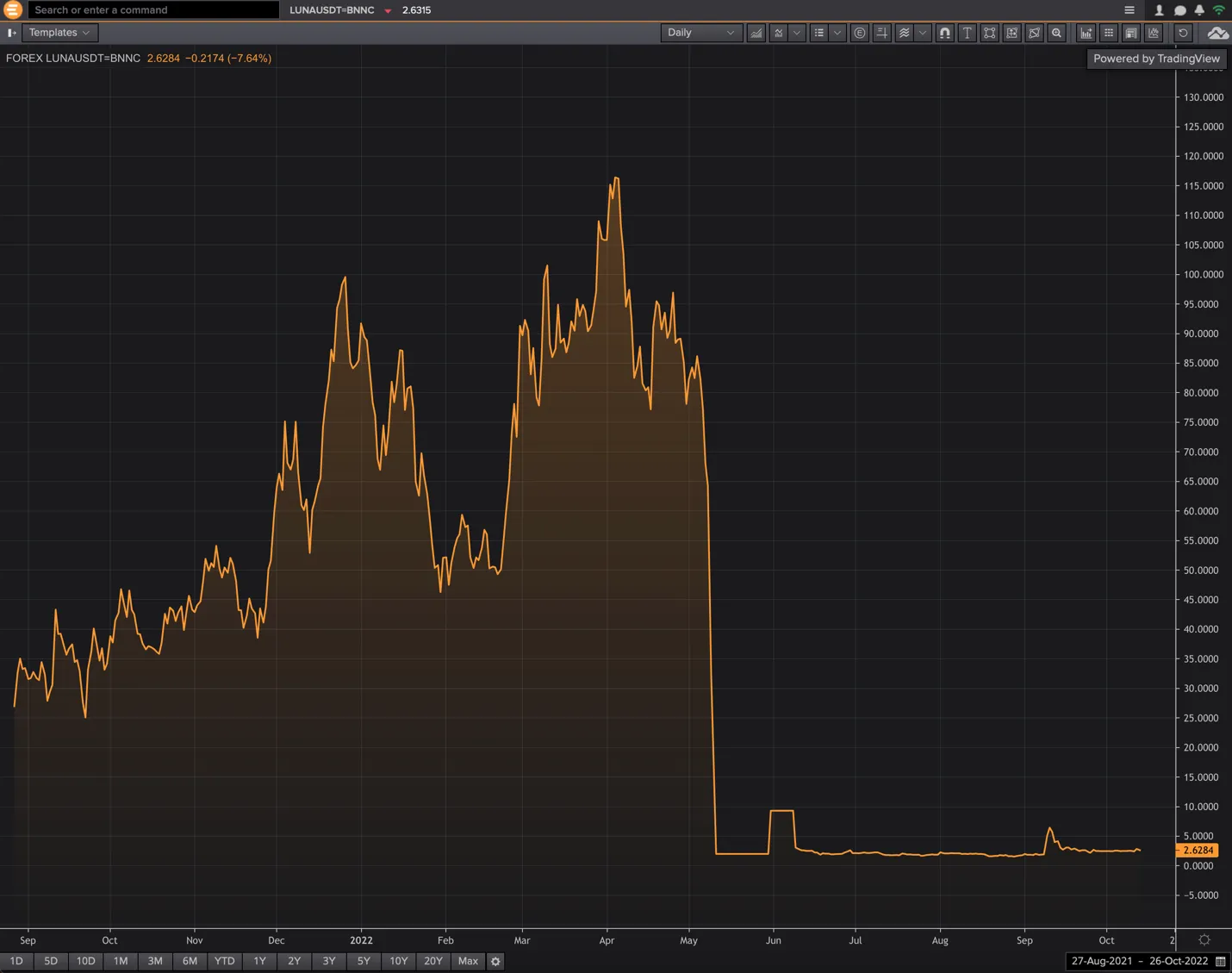
It started on 7 May 2022 with a few large sales that pushed UST just below a dollar. Normally nothing special. But confidence was paper-thin, and doubt turned into panic. Customers pulled billions out of Anchor. UST slipped further — and then the death spiral began: the deeper UST sank, the more LUNA the system minted to rescue the peg, which made the LUNA supply explode and its price collapse, which undermined confidence in UST even further. A downward vortex nobody could escape.
In the middle of the collapse, while millions of people watched their savings evaporate, Kwon posted a tweet that would become the symbol of his hubris:
Deploying more capital — steady lads.Do Kwon, 9 May 2022, while LUNA was in free fall
Nothing about it was steady. The bitcoin war chest was emptied to break the fall: of more than 80,000 bitcoin, 313 were left within days. It made no difference. LUNA crashed from around $120 to a fraction of a cent — the supply swelled by almost two million percent. UST, the “stable” dollar, bottomed out around thirteen cents. In total, more than forty billion dollars evaporated.
The human damage was devastating. Hundreds of thousands of small investors, many of them in South Korea, lost everything. A desperate man who had lost $2.3 million broke into Kwon's home. And the shockwave dragged half the sector down with it: hedge fund Three Arrows Capital, lenders Celsius and Voyager — and ultimately the wreckage contributed to the fall of FTX later that year. On 13 May, Kwon tweeted that he was “heartbroken”. But eight days before his own downfall, an interview had already shown how he viewed such disasters:
95% are going to die, but there's also entertainment in watching companies die too.Do Kwon, shortly before the collapse of his own coin
The manhunt
When the dust settled, Kwon had vanished. While South Korean prosecutors opened an investigation, he had already left the country. On 14 September 2022 a court in Seoul issued an arrest warrant. Kwon responded from the shadows with a tweet insisting he was absolutely “not on the run” and had nothing to hide. Twelve days later Interpol issued a red notice: wanted, worldwide.
What followed reads like a spy thriller. From Singapore to Dubai, and on — via Serbia — to Montenegro. His South Korean passport was revoked. And according to US prosecutors, his attitude towards the authorities hunting him was as brazen as his tweets: his strategy, he said in a recorded conversation, was simply to tell governments “to fuck off” — and he was counting on “political protection”. The king thought he was untouchable.
The tarmac in Podgorica
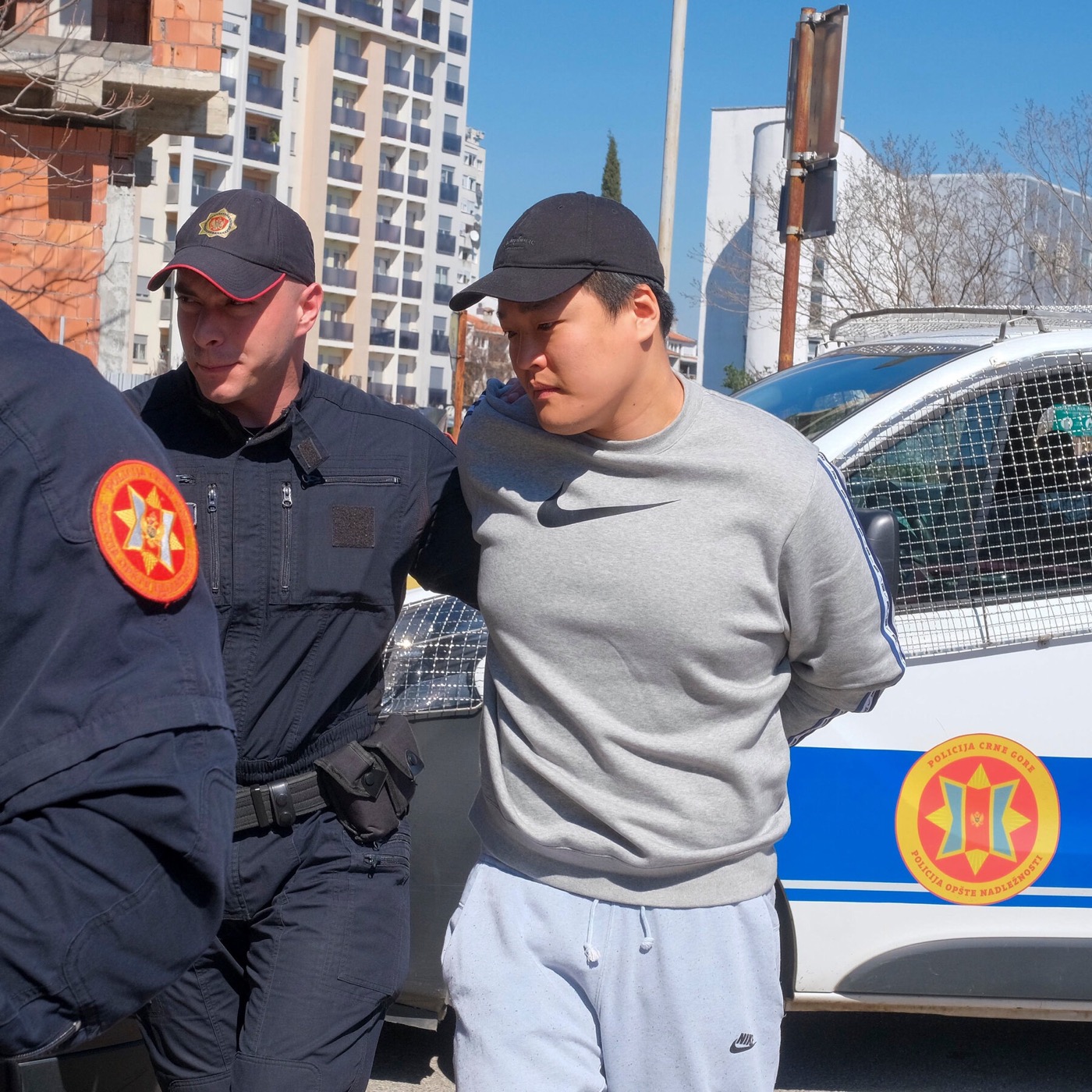
On 23 March 2023 it went wrong. At the airport of Podgorica, the capital of Montenegro, a private jet stood ready for a flight to Dubai. Do Kwon was about to board it, together with his chief financial officer Han Chang-joon. But a border guard did not trust the passport Kwon handed over — a forged Costa Rican document.
The search turned up a complete escape kit: two false Costa Rican passports, two Belgian ones, and two identity cards. The man who said he was not on the run was travelling with a handful of forged identities. Montenegro sentenced him to four months in prison for document fraud. And then the international tug-of-war began: both the United States and South Korea wanted him. For months Montenegrin courts pushed him back and forth — until the justice minister signed off on extradition to the US at the end of 2024.
The bill
The bill came in layers. First the civil case: in April 2024 a US jury found that Kwon and Terraform had committed securities fraud, followed by a settlement with the securities regulator SEC of nearly $4.5 billion. On 31 December 2024 Kwon was extradited to the US. In August 2025 he pleaded guilty to two serious charges. Prosecutors put the number of victims at more than one million people.
And on 11 December 2025 the sentence came down. Judge Paul Engelmayer called even the prosecutors' request — twelve years — “unreasonably lenient”, and added more on top.
Your offense caused real people to lose $40 billion in real money.Judge Paul Engelmayer, to Do Kwon, 11 December 2025 proven
Fifteen years in prison, plus more than nineteen million dollars in forfeiture. The man who once refused to speak to “the poor” was now himself on the wrong side of the courtroom — convicted of what prosecutors called “one of the largest frauds in history”.
What Terra proved
Do Kwon sold a promise as a guarantee. A “stablecoin” with no real backing is not a vault full of dollars — it is a story that works as long as enough people believe it, and collapses the moment they stop. The arrogance, the bets, the “steady lads” — these were not jokes in hindsight, they were the warning signs in advance.
And that is exactly why regulation now exists that reins in this precise type of coin. Under Europe's MiCAR law, a stablecoin may no longer call itself “stable” without real, demonstrable reserves standing ready one-for-one — no home-made sister coin, no algorithmic trick. It is the single rule that would have made the entire Terra tragedy impossible.
The king called his coin his greatest invention, and named his daughter after it. What he actually invented was a way to make forty billion dollars disappear in seven days. The question he leaves behind is simple: if a coin is called ‘stable’ — who guarantees that, and with what real money?
Sources
15-year sentence & “$40 billion in real money” (11 Dec 2025) and the secret 2021 peg rescue: DOJ. Guilty plea (Aug 2025): DOJ. SEC settlement $4.47bn: SEC. Podgorica arrest + false passports: BalkanInsight, CoinDesk. LFG bitcoin reserve 80,394 → 313 BTC: CoinDesk. Arrest warrant + Interpol: CNN. “I don't debate the poor” & “steady lads”: X/@stablekwon, widely quoted.