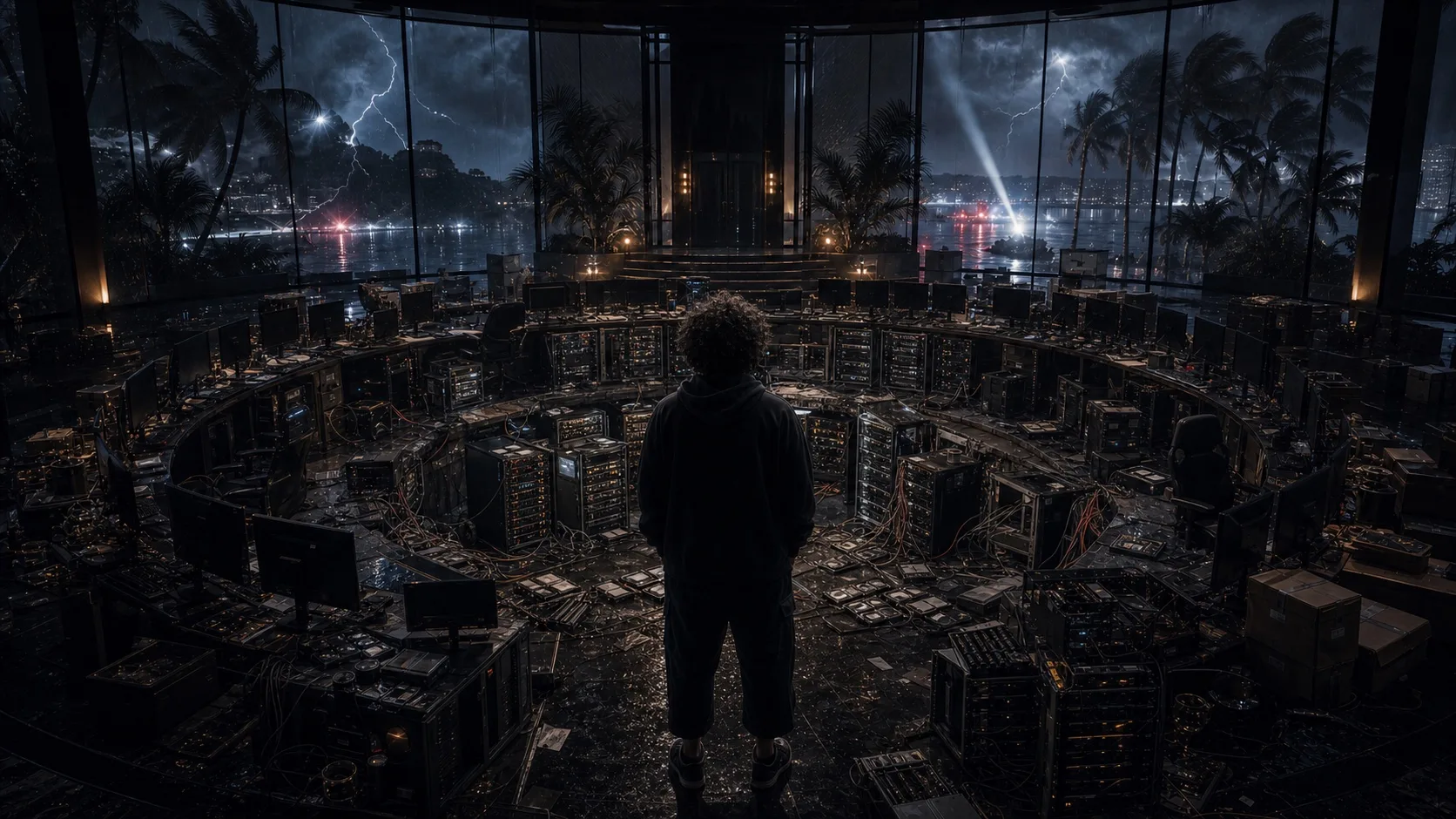
He was crypto's friendliest billionaire: unruly curls, cargo shorts, a life he said he was devoting to “saving the world”. Behind that mask, Sam Bankman-Fried borrowed eight billion dollars of customer money that was not his. This is how crypto's “good guy” became the biggest financial fraudster of his generation — and why he is now serving 25 years.
The messiah who was no messiah
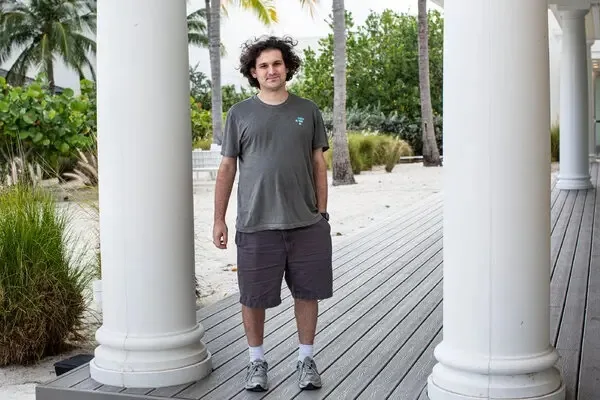
To understand how tens of billions could evaporate, you first have to understand the costume. In 2022, Sam Bankman-Fried — “SBF” — was the face of respectable crypto. On paper his exchange FTX was worth $32 billion. There was a giant Super Bowl ad, a basketball arena in Miami carried his name, Tom Brady was on board. And SBF himself? He drove a Toyota Corolla, slept on a beanbag, and preached effective altruism: earn billions, in order to give them away.
The press was smitten. He shared stages with Bill Clinton and Tony Blair, testified before the US Congress, and became one of the country's largest political donors. The scruffy genius nerd who wanted to make the world better — it was a story everyone wanted to believe.
It was a costume. Later, in private messages to a Vox journalist, SBF let the mask slip: his carefully built ethics image was largely “a front”. About the regulators he embraced in public, he wrote two words.
Fuck regulators.Sam Bankman-Fried, in private messages to Vox, November 2022
Two companies, one wallet
The deception turns on two companies. The first is FTX: the exchange, where ordinary customers parked their money and crypto to trade. The second is Alameda Research: SBF's own hedge fund, which gambled with that kind of money on the markets.
The golden rule of any exchange is sacred and simple: you do not touch customer money. It sits separately, it belongs to the customer, full stop. And SBF swore publicly, over and over, that FTX and Alameda were entirely separate, at arm's length, with no preferential treatment.
That was the lie. In reality the two shared one pot. And that pot belonged to the customers.
The back door in the code
Here is the heart of it — and this is not opinion, it was proved in court. Co-founder Gary Wang built, on SBF's instruction, a secret exception into FTX's software. While every ordinary customer was automatically liquidated the moment their positions went into the red, Alameda was exempt from that rule. It received an all but bottomless credit line: Alameda could draw billions in customer balances and run endlessly negative. A hidden flag in the code — invisible to customers, unseen by auditors.
Through that back door, Alameda pulled more than eight billion dollars of customer money towards itself. Money customers believed was sitting safely in their accounts was quietly funnelled into the boss's gambling fund.
SBF called it “borrowing”. His own people — Wang, and his ex-girlfriend and Alameda chief Caroline Ellison — testified about it. The jury had a shorter word: theft. And years later, when SBF's lawyers argued on appeal that the customers “would have been repaid in the end anyway”, the court swept that defence aside.
The fraud happens the moment you take someone's money from them — even if you intend to pay it back one day.Core of the US appeals court ruling, 12 June 2026
The party in the Bahamas
Where did those eight billion go? Into a party. FTX was run from the Bahamas, where a handful of twenty-somethings steered a global empire from a $30 million penthouse in the luxury Albany resort. Hundreds of start-ups were funded recklessly, naming rights and ad slots were bought, and SBF spread political money around like water — on both sides of the spectrum.
And then there was FTT: FTX's own coin, which the company had conjured out of thin air. Alameda held enormous piles of it and used them as “collateral” — self-printed play money meant to hide the hole in the vault. As long as the market went up, nothing showed. But the whole house of cards rested on a coin the company could print more of itself. And the party was paid for with the savings of customers who thought their money was simply sitting in their accounts.
Four days in November
The end came in a single week. On 2 November 2022, news site CoinDesk publishes a leaked Alameda balance sheet — stuffed with that home-made FTT. The market flinches. On 6 November, Changpeng “CZ” Zhao, the boss of rival Binance, tweets that he is dumping his entire pile of FTT. Panic sets in. A classic bank run: customers stampede for the exit to withdraw their money.
On 7 November, with the building on fire, SBF tweets:
FTX is fine. Assets are fine.Sam Bankman-Fried, 7 November 2022 — tweet later deleted
The next day withdrawals are halted. The hole can no longer be hidden: the billions customers thought they owned are not there. Alameda has spent them. On 11 November FTX files for bankruptcy; SBF steps down. A new man takes the helm: John J. Ray III, the veteran who once cleaned up the wreckage of Enron. His verdict was devastating.
Never in my career have I seen such a complete failure of corporate controls.John J. Ray III, incoming FTX chief, in the bankruptcy filings
The betrayal
On 12 December 2022, SBF is arrested in the Bahamas and extradited to the United States. And then his inner circle falls like dominoes. Caroline Ellison — Alameda's chief and his ex-girlfriend — pleads guilty. So do co-founder Gary Wang and executive Nishad Singh. All three turn and testify against him.
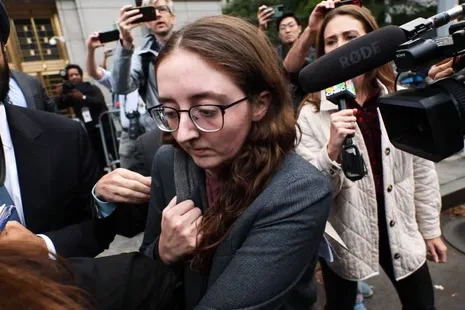
In the courtroom, in October 2023, Ellison tells the jury flatly that SBF directed the crimes. The nice-guy aura is gone; what remains is a man who blames everyone but himself.
The verdict
On 2 November 2023 — exactly one year after the CoinDesk article that lit the fuse — the jury delivers: guilty on all seven counts. Fraud, conspiracy, money laundering. On 28 March 2024, Judge Lewis Kaplan passes sentence: 25 years in prison and $11 billion in forfeiture. The judge pointed to SBF's evasive testimony and to a real risk that he would do it again. Caroline Ellison, who cooperated, later received two years.
The bill
SBF did not give up. But on 12 June 2026 the appeals court rejected his case in a scathing 42-page ruling, demolishing his main defence: that the customers “would have been made whole anyway”. He filed a request for a presidential pardon and is today held in a low-security prison near Santa Barbara.
And the customers? Under John Ray's leadership the FTX estate has meanwhile recovered and paid out almost ten billion dollars — many customers get back 100 to 120% of their claim. Sounds like a happy ending. But there is a nasty catch: they are repaid at the dollar prices of November 2022, the bottom of the market. Anyone who held bitcoin on the exchange back then gets the low value of that moment — not what the same bitcoin was worth later. Made whole on paper; in practice robbed of years of price appreciation. The wind-down runs into 2027.
What FTX proved
Let there be no confusion. SBF did not lose customer money. He took it, spent it, and the modest-genius image was precisely the tool that made people hand it over. Michael Lewis got a novel out of it (Going Infinite); the jury wrote a shorter verdict: guilty.
And the wall that could have stopped him is the same one BitMEX and Mt. Gox lacked. Under Europe's MiCAR law, a licensed exchange must legally segregate client money from its own funds, and may not lend that money to an affiliated trading fund. That one rule — whose absence turned FTX customers into unsecured creditors of a fraudster.
The cargo shorts hung well. The smile was convincing. And that was exactly the danger. The question FTX leaves behind is not whether an exchange looks nice, but: is it even allowed, by law, to touch your money?
Sources
Conviction on all 7 counts & 25 years / $11bn (Judge Kaplan): DOJ. Appeal rejected (12 June 2026) + pardon request: CNBC, Forbes. “Fuck regulators” / ethics as a ‘front’: Vox. “Complete failure of corporate controls” (John Ray, bankruptcy filing); FTX repayments ~$10bn, 100–120%: CoinDesk, AMBCrypto.