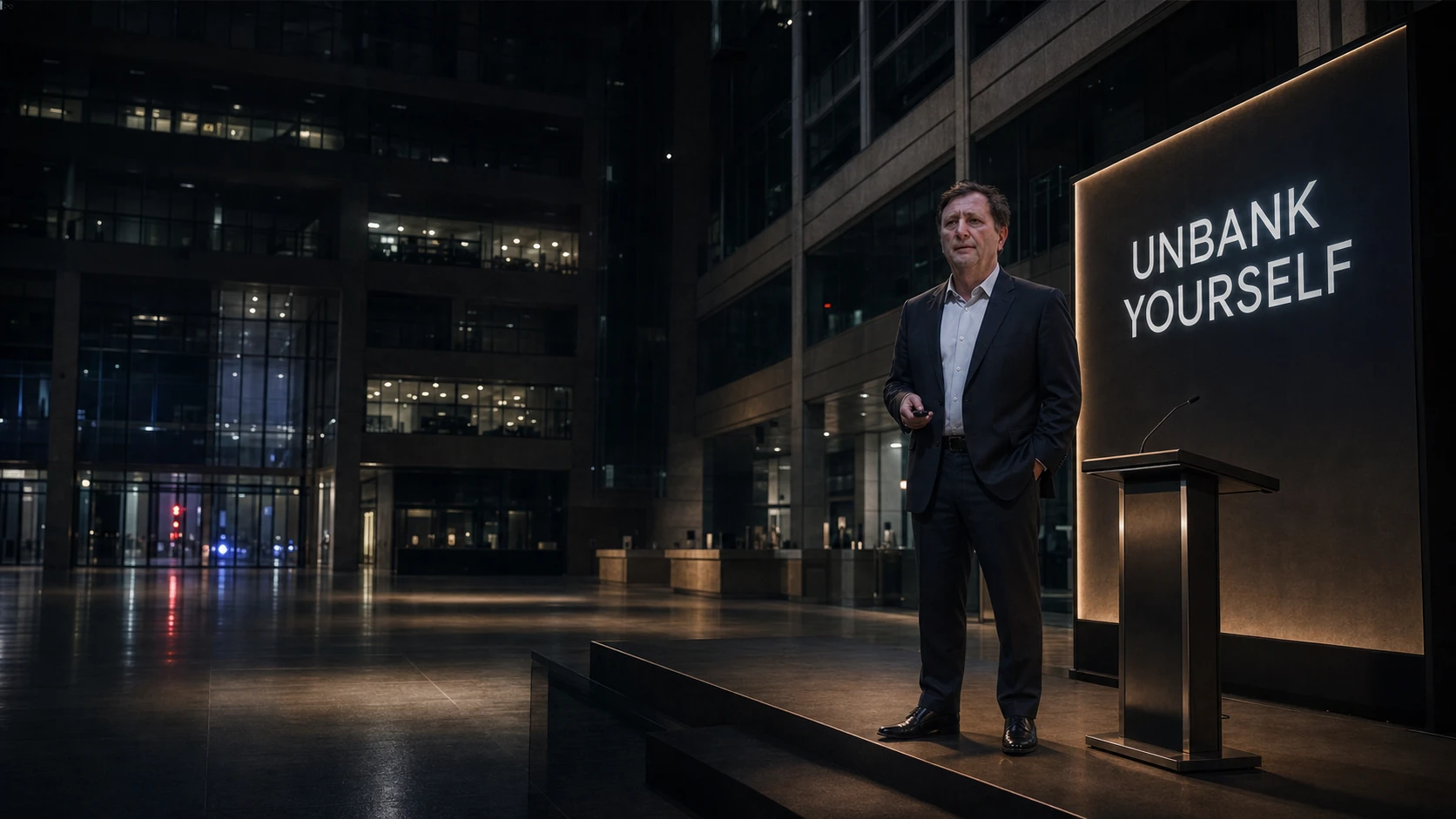
He wore a T-shirt reading “banks are not your friends”, promised ordinary people 18% interest where their savings bank paid 0.1%, and swore live every week that their money was safe. Behind the scenes, Alex Mashinsky pumped up his own coin, quietly sold it for tens of millions, and pulled his own money out — while begging customers to keep depositing. This is the story of Celsius: how the man who hated banks did exactly what he accused them of, and ended up with twelve years in prison.
The prophet of “unbank yourself”
Every revolution needs a speaker, and Alex Mashinsky was a born salesman. A Ukrainian-Israeli entrepreneur who had moved to New York and presented himself as an unrecognised genius — he claimed to have worked on early internet telephony and to hold dozens of patents. In 2017 he founded Celsius Network, and he packaged it not as a company but as a movement.
His message was simple and seductive: the banks are robbing you. They lend out your savings at hefty rates and hand you back a pittance. Celsius would put that right and give the profit back to ordinary people. His slogans became T-shirts and tattoos for his fans: “Unbank Yourself” and, over and over:
Banks are not your friends.Alex Mashinsky, the heart of the Celsius marketing
It was an indictment of the financial world. And the painful part is that, on paper, he was right about that world. Which is exactly why so many people believed him when he said he would do better.
The promise of 18 percent
The engine under the movement was a number too good to be true: interest of up to 17 or 18 percent on your crypto. You deposited your bitcoin or stablecoins with Celsius, and every Friday interest was paid out — in crypto. For a generation earning almost nothing on their savings account, it was irresistible.
How was that possible? Celsius lent out customers' deposited crypto and put it to work: loans to traders and institutions, staking, and increasingly risky DeFi strategies. In theory Celsius earned more than it paid out to customers, and kept the margin. In practice the yield had to beat the competition every time, so the bets got bigger and more dangerous. At the peak, some $20 billion in customer money flowed through Celsius in total.
And there was a catch most customers never read. In the small print it said that the moment you deposited, you were legally no longer the owner of your crypto — you had lent it to Celsius. You were not a saver. You were a creditor. Exactly what Mashinsky accused the banks of, he had written into his own terms.
Ask Mashinsky Anything
What really held Celsius together was not technology but trust — and Mashinsky cultivated that trust personally, every week. In his livestream “Ask Mashinsky Anything” he spoke directly with his community, reassuring, fatherly, always optimistic. He repeated that Celsius was safer than a bank, that it had more than enough reserves, that it had never let a customer down.
Celsius has billions in liquidity... Celsius is one of the safest places in the world for your crypto.The gist of Mashinsky's weekly reassurances to customers alleged
Prosecutors would later argue that at those very moments he knew it was untrue. While he looked into the camera and said everything was solid, the reserves had been hollowed out, losses were mounting, and there were holes in the balance sheet he kept hidden. The AMA was not transparency. It was, according to prosecutors, the tool that kept people depositing.
Where the yield really came from
Behind the reassuring numbers sat a machine taking on water. Celsius promised more interest than it could sustainably earn, and covered the gap with ever riskier moves. It parked enormous sums in opaque DeFi protocols, went yield farming, and sometimes lent out against too little collateral. When a series of shocks rolled through the sector — including the collapse of Terra/Luna in May 2022 — it became clear how shaky the structure was.
Alarm bells had rung earlier. Celsius lost money in external incidents and hacks, and had made promises it could only keep as long as the market kept rising. At its core the construction resembled what characterises every blow-up in this series: newly deposited money propped up the interest paid to existing customers. As long as more came in than went out, nothing showed. But the moment everyone wanted their money back at once, there was not enough.
The coin he pumped
There was a second game, and this is where it tips from recklessness into fraud. Celsius had its own coin: the CEL token. Customers who took their interest in CEL earned a higher rate, so there was demand. And Mashinsky, prosecutors established, actively manipulated that coin: Celsius systematically bought CEL to push the price up.
At the same time, Mashinsky was secretly selling his own CEL — at precisely the moments when that manipulation had the price high. In public he said the opposite:
I'm not selling my CEL — while he was quietly dumping tens of millions' worth.Core of the indictment against Mashinsky proven
According to prosecutors he pocketed some $42 to $48 million this way. The man who urged his customers to believe in the coin was quietly selling that coin to those same customers, while lying about what he was doing.
The quiet exit
And then the detail that makes the story unforgivable. In the weeks before the fall, while Mashinsky publicly kept insisting Celsius was rock solid and encouraged customers to keep depositing, he pulled his own money out. According to reporting he withdrew some ten million dollars from the platform; together with other executives it amounted to tens of millions taken out just before the freeze.
It is the classic image running through this whole series: the captain quietly climbing into the lifeboat while assuring the passengers the ship is not sinking. For the customers who stayed on his word, that exit would remain closed forever.
12 June 2022: the pause
On 12 June 2022 the mask came off. In a cold statement, Celsius announced that “due to extreme market conditions” it was pausing all withdrawals, swaps and transfers. Overnight, more than a million customers could no longer reach their money. The interest that had been paid every Friday had evaporated; the savings behind it were locked.
On 13 July 2022 Celsius filed for bankruptcy. The figures were devastating: more than 100,000 creditors with claims totalling some $4.7 billion, and a hole in the balance sheet of over a billion. The people Mashinsky had promised to liberate from the banks were now at the back of the queue in a bankruptcy court — as unsecured creditors, exactly as the small print had said.
The reckoning
The fall from crypto hero to defendant was fast. On 13 July 2023 Mashinsky was arrested. A whole row of US authorities came at him at once: federal prosecutors, the securities regulator SEC, the derivatives regulator CFTC and the consumer watchdog FTC; the New York attorney general had also sued him. The FTC reached a $4.7 billion settlement with Celsius and permanently banned the company from handling consumer assets.
In December 2024 Mashinsky pleaded guilty on two serious counts: commodities fraud and a scheme to manipulate the CEL token. And on 8 May 2025 the sentence came down. Judge John Koeltl imposed twelve years in prison — between the one year the defence asked for and the twenty years prosecutors demanded.
He pocketed more than $45 million, while some of his customers lost everything and suffered severe psychological harm.Judge John Koeltl, at the sentencing on 8 May 2025 proven
The man who called banks “not your friends” turned out to be the most dangerous kind of banker himself: one who wins your trust with a promise to protect you, and uses that trust to rob you.
What Celsius proved
Celsius is the sharpest warning against one specific thing: the interest product. An attractive yield on your crypto sounds like free money, but it almost always means you have lent your holdings to someone who is gambling with them. At that moment you are no longer an owner but a creditor — and if the counterparty falls, you fall with it. That is exactly the same mechanism that trapped Gemini Earn customers and that fed Do Kwon's death spiral. The shape differs, the fall is the same.
And it is precisely what Europe's new rules rein in. Under MiCAR, a licensed provider must segregate client money from its own funds and be crystal clear about what happens to your holdings; misleading marketing and mixing client balances with the firm's own bets become criminal instead of a business model. The “banks are not your friends” story sold a feeling of freedom; what was missing was the boring infrastructure that actually protects your money.
Mashinsky was right that you should look critically at your bank. He simply proved, in the cruellest way, that a charismatic man in a slogan T-shirt is far less your friend. The question Celsius leaves behind is the thread running under all these stories: when someone promises you a return nobody else offers — who are you actually lending your money to, and what happens when he falls?
Sources
Indictment (fraud + CEL manipulation, ~$42M, undisclosed sales, reassurances before the “Pause”): DOJ (SDNY). Guilty plea (Dec 2024): Fortune. 12 years in prison + “pocketed over $45M” (Judge Koeltl, 8 May 2025): CNBC, CoinDesk. ~$10M withdrawn before the freeze: Axios. Freeze 12 June 2022 & $4.7bn / 100,000+ creditors: Reuters. FTC settlement $4.7bn + permanent ban: FTC.