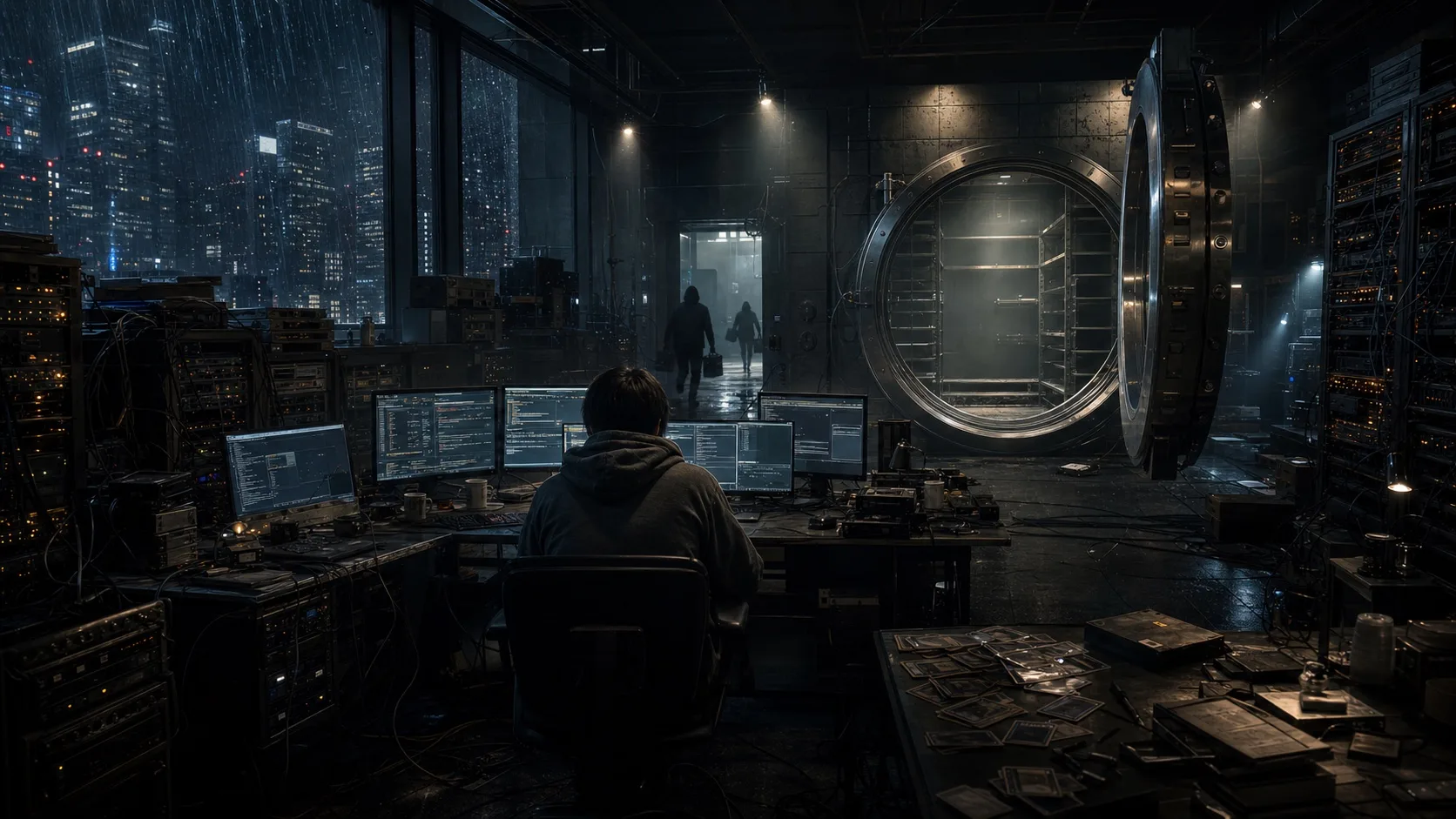
It began as a swap shop for trading cards and grew into the place where seven out of every ten bitcoin on earth were traded. Then 850,000 bitcoin evaporated. This is the story of Mt. Gox — the first king of the crypto market, the nerd who took the blame, and the Russian hackers who turned out to be the real thieves.
A swap shop for fantasy cards
The name alone gives away how small this started. Mt. Gox — in full, Magic: The Gathering Online Exchange. Programmer Jed McCaleb had registered the domain in 2007 so players could trade their fantasy cards. When that went nowhere, he rebuilt it in 2010 into something new: a place where you could buy and sell that strange new digital coin, bitcoin.
It was a joke that got out of hand. Within a year Mt. Gox was the largest bitcoin exchange in the world. And McCaleb, who had better things to do, offloaded the thing in early 2011 — to a Frenchman in Tokyo.
The French king of Tokyo
That Frenchman was Mark Karpelès: a mild-mannered, bespectacled programmer who looked more like a shy anime character than a financial tyrant. He moved to Tokyo, spoke halting Japanese, and ran from a small office what was rapidly becoming the beating heart of the entire crypto market.
At its peak, roughly 70% of all bitcoin transactions on the planet ran through Mt. Gox. Millions of dollars a day flowed through one man's servers. Karpelès held the keys to the kingdom — literally, because he controlled the wallets. He was king.
But a king sitting on a volcano.
The chaos behind the curtain
Behind the smile it was a mess of epic proportions. Security was amateurish: private keys were scattered across hot wallets like sweets. There was barely any proper bookkeeping or logging. Customers complained ever more often that withdrawals were stalling. And on the exchange itself a trading bot was probably running — later christened “Willy” — that pushed the price up artificially.
Karpelès kept saying everything was under control. In reality nobody really knew how much bitcoin was still in the vault. And that was not a detail. That, as it turned out, was the whole problem.
The grey day in February
In early February 2014 Mt. Gox freezes withdrawals “for technical reasons”. The unease swells. And then, around 24 February 2014, the site simply goes offline. A few days later the company files for bankruptcy protection in Japan.
Around 850,000 bitcoin had “disappeared” — some $450 million. The biggest theft the internet had ever seen.Mt. Gox bankruptcy filing, February 2014 proven
Of those 850,000 bitcoin, roughly 750,000 belonged to customers. Reddit exploded. People wanted blood. And the bespectacled Frenchman went from the boy who accidentally became king to the villain of the story.
The villain everybody wanted
Japanese police arrested Karpelès in August 2015. The charges: embezzlement, and tampering with the records. In the courtroom he sat there — too quiet, wearing those same glasses — while prosecutors demanded ten years in prison for embezzling millions in customer money.
The world had its culprit. The story looked finished. But it did not add up.
The plot twist
In March 2019 the verdict came, and it caught everyone off guard. The Tokyo court acquitted Karpelès of embezzlement — he had, the judge ruled, acted without criminal intent. He was guilty only of fiddling with the digital records: a suspended sentence of two and a half years. No prison. The king had been a mess, not a thief.
So who had stolen 850,000 bitcoin? The answer only came years later, and from the other side of the world. In June 2023 the US Department of Justice unsealed an indictment against two Russians: Alexey Bilyuchenko and Aleksandr Verner.
As early as September 2011 the hackers had broken into a Mt. Gox server in Japan — and drained the vault until at least 2014. At least 647,000 bitcoin.US DOJ indictment, June 2023 proven
Read that again. From 2011 — before Karpelès had properly understood what he had bought — Mt. Gox was already bleeding out. The coins trickled away for years, unnoticed, while the Frenchman went on believing his vault was full. He had not inherited an empire but a leaking ship. And the stolen money was laundered through another notorious exchange, BTC-e, run by the same Bilyuchenko together with fellow Russian Alexander Vinnik.
The treasure that came back
And then the twist that turns this into a proper adventure novel. While the bankruptcy proceedings dragged on for years, the trustee found something in an old, forgotten wallet format: roughly 200,000 bitcoin nobody had on the radar any more. A treasure map pulled out of a dusty drawer in Tokyo.
That find changed everything. Because the bitcoin that had “evaporated” at some $450 million in 2014 was by now worth many times that. In 2024 trustee Nobuaki Kobayashi finally started repaying — not in dollars, but in bitcoin and bitcoin cash. Creditors who had been left in limbo for a decade got back coins that had turned into gold in the meantime.
The file still drags on: the repayment deadline has since moved to 31 October 2026, and the estate still holds tens of thousands of bitcoin — the largest unfinished estate of any fallen exchange ever. Twelve years after the collapse, Mt. Gox is still paying out the dead.
What Mt. Gox taught us
No story has shaped the crypto market more deeply. Mt. Gox was the original trauma: the moment a generation learned that “your coins on an exchange” means somebody else holds your keys. Out of that pain came the habits that are standard today: cold storage, the demand for Proof of Reserves, and eventually the call for real supervision that in Europe became MiCAR — with mandatory segregation of client money and a traceable, liable entity.
Because that is the eternal difference Mt. Gox exposed. At an exchange with no supervision and no segregated client funds, you are not the owner of your bitcoin — you are a creditor. And if the vault ever turns out to be empty, it can take twelve years to find out how much is left.
The French king was dethroned long ago. But the question he left behind is still standing tall: are you sure the vault is full — and who holds the key?
Sources
Karpelès verdict (acquitted of embezzlement, guilty of data manipulation): Japan Times, CoinDesk. The real culprits — DOJ indictment of Bilyuchenko & Verner (~647,000 BTC from 2011, laundered via BTC-e): justice.gov, The Record. Repayment & October 2026 deadline: CoinDesk, CoinMarketCap.