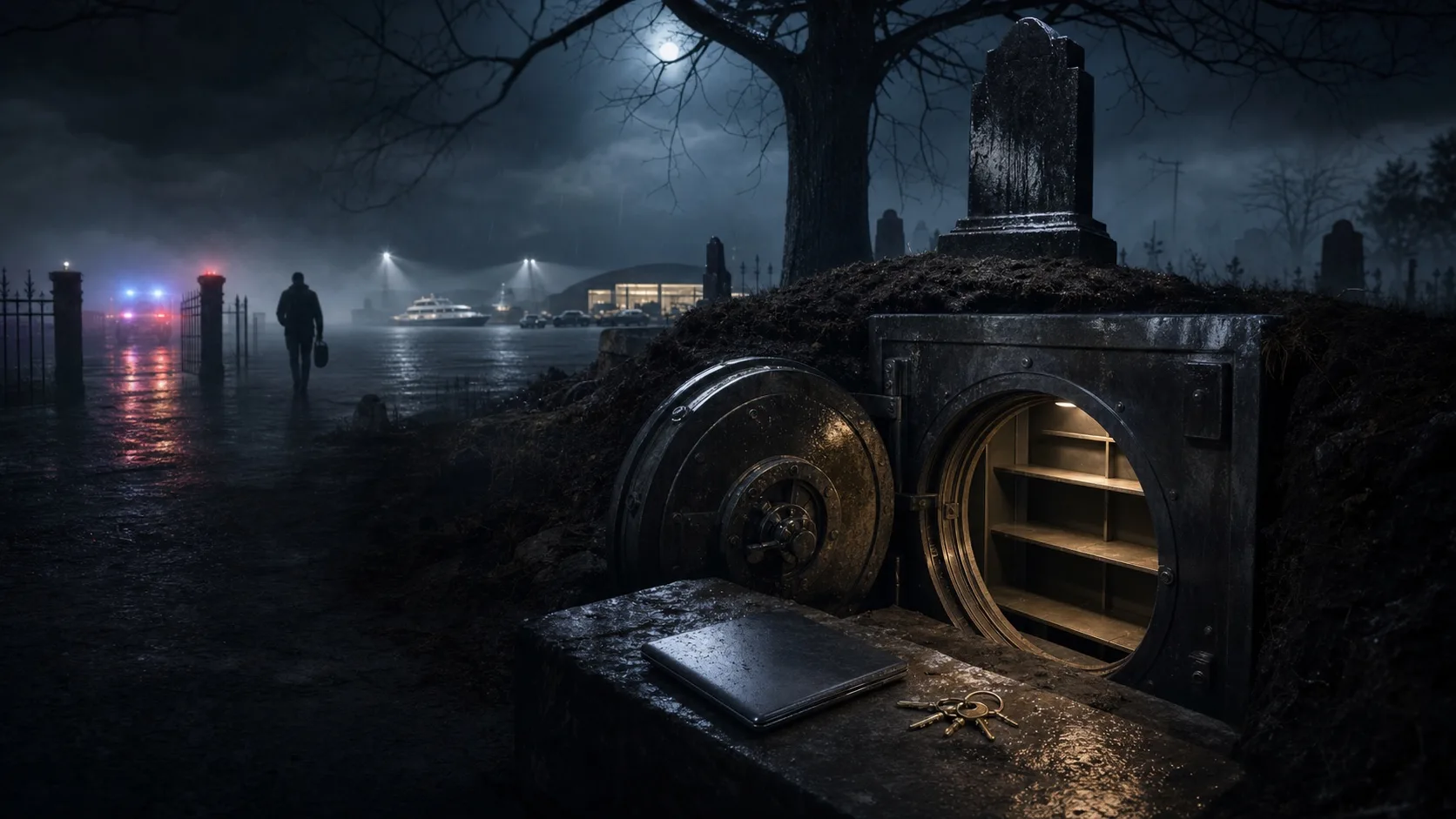
A 30-year-old CEO dies suddenly on his honeymoon in India. He was the only one with the keys — and $190 million of customer money is locked away forever. A tragic accident, it seemed. Until someone opened the vault and found it had been empty all along. This is the story of QuadrigaCX: the dead king, the vanished keys, and the Ponzi scheme underneath.
A death in Jaipur
December 2018. In a hospital in Jaipur, India, Gerald Cotten, 30 years old, dies of complications from Crohn's disease. He is on honeymoon with his new wife. On the other side of the world, in Canada, nobody knows yet — and nobody realises that something far bigger died with this one man.
Because Cotten ran QuadrigaCX, Canada's largest crypto exchange. And he took something to his grave: the passwords.
The Crypto King
QuadrigaCX was the success story of Canadian crypto. At its peak it managed the balances of some 76,000 customers. And Cotten was the face of it: a boyish, friendly techie who travelled the world with his laptop, a bitcoin evangelist, always reachable, always reassuring. Customers handed him their savings the way you hand a nice neighbour your house key.
That trust was, in hindsight, precisely the problem. Because Cotten did not just have the key to the house. He had the only key to the vault — and nobody ever checked what was inside.
The man with all the keys
At QuadrigaCX, Cotten was everything at once: sole director, sole key holder, sole point of contact. Customer crypto sat, the company said, safely in cold wallets — offline, uncrackable. And only Cotten knew the passwords.
After his death, the exchange was therefore in checkmate. Roughly $190 million in customer balances was locked inside wallets nobody could open. The widow swore in an affidavit that she did not have the passwords. The laptop was encrypted. It looked like the cruellest bad luck in crypto history: one man dies, and the money of 76,000 people is out of reach forever.
Except it was not true.
The empty vault
When investigators from Ernst & Young — appointed to clear up the wreckage — finally got to the famous cold wallets, they found something nobody expected. The vaults were largely empty. And had been for months.
The money was not stuck behind a lost password. It simply was not there any more. The investigators traced more than 67,000 unauthorised transfers that had siphoned customer funds off to accounts Cotten controlled himself. The “dead CEO with the keys” was not the victim of a tragedy. He was the perpetrator of a crime.
The fraud underneath
In June 2020, after ten months of investigation, the Ontario Securities Commission laid the whole construction bare. The verdict was devastating, and its opening line became instantly legendary:
What happened at Quadriga was an old-fashioned fraud wrapped in modern technology.Ontario Securities Commission, report June 2020 proven
The facts, as the regulator reconstructed them: Cotten opened accounts under false names, credited them with fictitious balances — money that did not exist — and traded with it against his own, real customers. When those fake positions lost money, a hole opened up. And he filled that hole with other customers' money: a classic Ponzi scheme. Of the roughly $169 million in customer losses, some $115 million was the result of Cotten's fraudulent trading — gambled away on other exchanges, with other people's money.
And he was not alone. QuadrigaCX was co-founded by a certain “Michael Patryn” — a name that, according to several investigations, was an alias for Omar Dhanani, a man with a conviction for identity fraud to his name. The exchange where Canadians parked their savings was built from the foundations up by people with a loose relationship to the truth.
The life of a king
Where did the money go? Into a life no 30-year-old can pay for honestly. Cotten and his wife bought houses across Nova Scotia and beyond, an aircraft, a sailing yacht, luxury cars, and travelled the world in business class. All of it paid for with deposits from customers who believed their bitcoin was safe in a cold vault.
The grave nobody opened
And then began the conspiracy that made the story immortal. Because if the vault was empty and the life a lie — how sure were we that Cotten was really dead? The circumstances were strange, to put it mildly: a sudden death, in a faraway country, during the honeymoon, with a death certificate that misspelled his name.
In late 2019, lawyers for the defrauded customers formally asked the Canadian police to exhume the body — to establish with certainty that the man in the grave really was Gerald Cotten. The widow said she was “heartbroken” by the request.
The body was never exhumed. And so the biggest question goes unanswered: does Gerald Cotten really lie in that grave in Nova Scotia — or did he step off somewhere with the keys to a looted vault?
The bill
The widow, Jennifer Robertson, eventually handed a large part of the assets back to the estate — houses, vehicles, the aircraft, the yacht, some twelve million dollars' worth of possessions. But for the 76,000 customers that was a drop in the ocean: in the end they got back only a fraction of their money. The story became a Netflix documentary (Trust No One: The Hunt for the Crypto King) and a pile of books. The coins? Mostly gone.
What Quadriga proved
Quadriga is the most chilling proof of one simple truth: at an exchange without supervision there is nothing — no law, no audit, no backup — protecting you from one man with all the keys. There was no segregation of client money. There was no second director. There was no accountant who had ever opened the vault. The whole structure hung on trust in a single boyish smile.
And that is exactly what regulation such as Europe's MiCAR is meant to make impossible. A licensed exchange must segregate client money, must demonstrably safeguard it, must have proper governance and controls — never again should a “Gerald Cotten” be the only person who knows whether the vault is full or empty.
The king is dead, ran the announcement. But the real question Quadriga left behind is one you should ask yourself at every exchange: has anyone ever looked inside that vault independently?
Sources
OSC report (“old-fashioned fraud wrapped in modern technology”, Ponzi, fake accounts, ~$169M in losses): CBC, OSC (full report, PDF). Death in India & ~$190M locked: Fox. Exhumation request + widow's response: CBC, Global News. Cold wallets largely empty / 67,000 transfers (Ernst & Young investigation): CryptoPotato.