Who holds one? The verified list is here — ten entities, with register numbers.
1. Introduction
MiFID II (Markets in Financial Instruments Directive) is the classic European securities legislation that existed long before crypto. Since crypto derivatives and tokenised stocks emerged, this licence is mandatory for exchanges offering those products in the EU.
On this site we show which exchanges have obtained MiFID II — and why it makes a big difference for the products you can trade.
2. What exactly is MiFID II?
MiFID II is an EU directive regulating financial instruments. It has applied since 2018 and was originally designed for traditional securities and derivatives. With the rise of crypto perpetuals and tokenised stocks, these products fall under MiFID II as well.
A MiFID II licence is issued by the national supervisor of one EU member state and works via passporting across all 27 countries. For crypto exchanges the most common variant is the Cypriot MiFID II licence issued by CySEC. Other jurisdictions include Malta (MFSA), Germany (BaFin) and Slovenia (ATVP).
Continue reading the article
3. Which exchanges hold MiFID II?
Fewer than five major crypto exchanges in the EU hold a MiFID II licence. It is more expensive and slower to obtain than MiCA, with capital requirements from €125,000 up to €730,000 depending on scope.
See the current overview: Which exchanges hold MiFID II?
4. Why do perpetuals need MiFID II?
Perpetual futures are, technically, financial derivatives: they derive from an underlying asset (e.g. Bitcoin) and involve leverage. That makes them derivatives within the meaning of MiFID II.
Exchanges offering perpetuals in the EU without MiFID II risk:
- Fines from national supervisors
- Forced shutdown of services
- Reputational damage
Some exchanges solved this with a technical workaround: they relabel their perpetuals as expiry futures with a term of, say, five years. See Perpetuals vs expiry futures for the details.
5. Why do tokenised stocks need MiFID II?
Tokenised stocks are digital representations of real shares. Under EU law they qualify as transferable securities, and therefore fall under MiFID II.
There are two flavours:
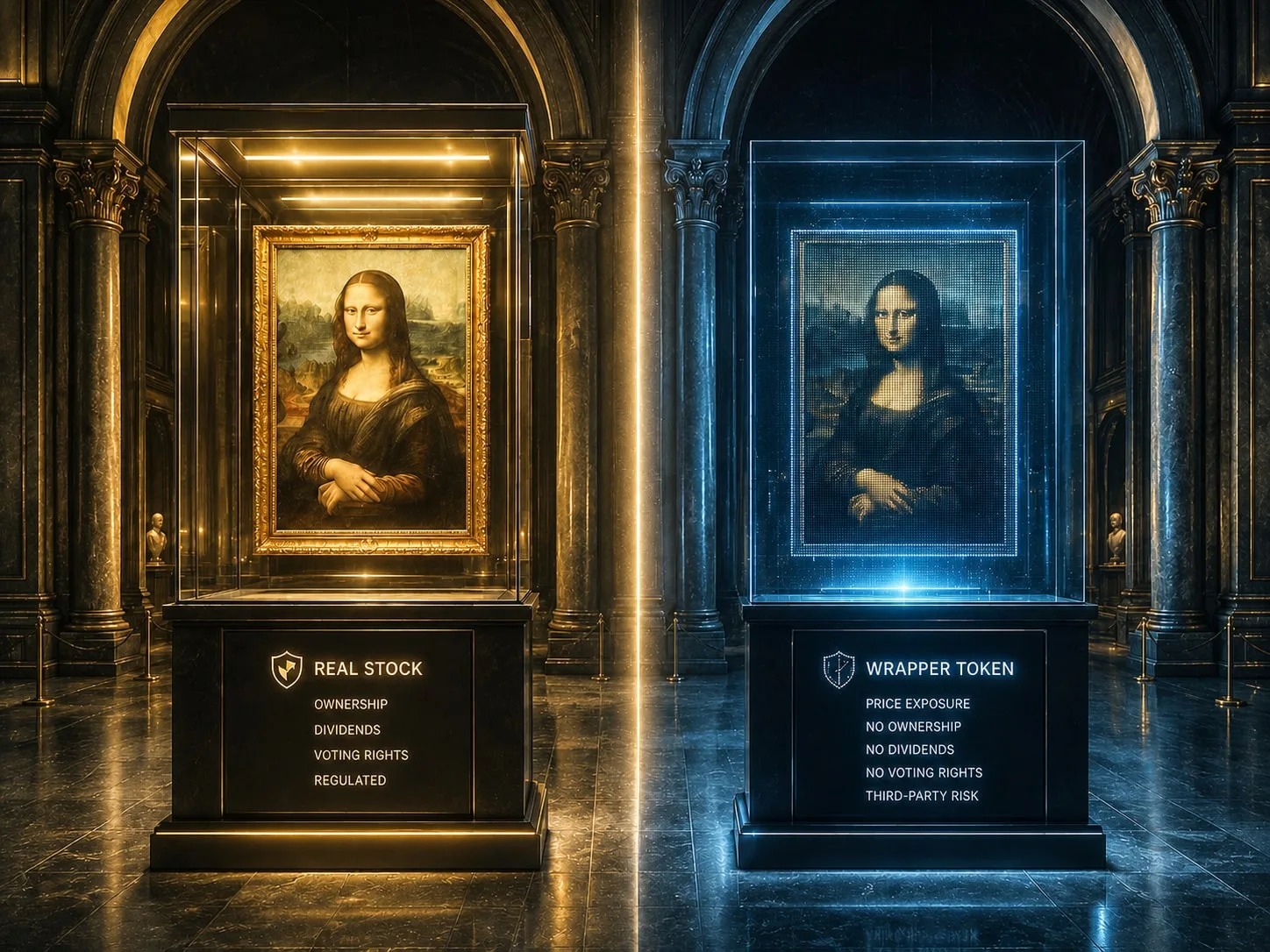
- Real shares on the blockchain — the token is a claim on a real share, typically held under New York UCC Article 8 or via an SPV. More in Real stocks vs wrapper tokens.
- Wrapper tokens — the token is a contractual claim on an issuer (often in Jersey or other offshore jurisdictions).
Both variants need MiFID II to be offered to EU users.
6. MiFID II vs MiCA
The biggest misconception on crypto Twitter is that MiCA covers "all crypto". It does not.
| Product | Licence |
|---|---|
| Buying spot Bitcoin or Ethereum | MiCA |
| Bitcoin perpetual future | MiFID II |
| Ethereum perpetual future | MiFID II |
| Tokenised Tesla share | MiFID II |
| Converting USDC to EUR (SEPA) | PSD2 |
7. Where do serious exchanges hold their MiFID II?
Several jurisdictions are popular for MiFID II in crypto:
- Cyprus (CySEC) — most common for crypto derivatives
- Malta (MFSA) — combination with MiCA possible in one jurisdiction
- Slovenia (ATVP) — smaller players and broker-like structures
- Germany (BaFin) — large financial institutions
8. What does MiFID II mean for you as a trader?
- Investor protection — appropriateness tests, negative balance protection, investor compensation schemes.
- Leverage limits — stricter caps for retail clients (typically 10x for crypto derivatives).
- Marketing rules — ads for leveraged products must carry warnings.
- Transparency — best execution, order routing reports, fee transparency.
- Complaints — access to a national investor compensation fund.
MiFID II is the older EU securities regime that governs everything MiCA does not: crypto perpetuals, other derivatives and tokenised stocks. It is expensive and slow to obtain, so fewer than five major crypto exchanges hold one — which is why some relabel perpetuals as long-dated expiry futures. For traders it brings leverage caps, negative-balance protection and access to investor compensation.
Frequently asked questions
Can I still trade offshore perpetuals?
Technically yes, via reverse solicitation — but without MiFID II protection.
What is the difference between MiFID II and MiFID I?
MiFID II is the 2018 update that strengthened transparency, best execution and investor protection.
Are client funds segregated?
Yes — MiFID II-licensed firms must hold client funds segregated with a custodian.