Two childhood friends built crypto's most powerful hedge fund, believed with religious conviction that the market would never really fall again, and borrowed billions to back that belief. They ordered a superyacht and named it “Much Wow”. When the market fell anyway, they dragged half the sector into the abyss with them — and went surfing in Bali. This is the story of Three Arrows Capital: the gods who thought gravity did not apply to them, and who showed not a shred of remorse even after the crash.
The supercycle
It starts with two boys who meet at secondary school: Su Zhu and Kyle Davies, classmates at the prestigious Phillips Academy in Andover, later fellow students at Columbia. Both sharp, competitive and utterly certain they were right. As students they already had a business plan: in Buenos Aires they wanted to teach local workers to play poker online and then take a cut of the winnings — a scheme that foundered on one detail nobody had thought of: neither of them spoke Spanish. After a stint as traders at Credit Suisse, in 2012, halfway through their twenties, they found Three Arrows Capital together — named after a Japanese legend: one arrow snaps easily, three arrows together do not.
They start with dull currency arbitrage, but around 2019 they find their calling in crypto. And Su Zhu develops an idea that becomes his trademark: the “supercycle”. His thesis: crypto is not in the usual up-and-down of bull and bear markets but in a years-long, near-endless rise that would send bitcoin past a million dollars. In short: it only goes up. He preached it like a faith to some 500,000 followers on X. Davies himself took a more casual view and described the whole fund as barely more than an online game: “if you're really good at the game, you make a lot of money.”
The supercycle thesis was, I have to admit, wrong.Su Zhu, April 2022 — shortly before everything collapsed proven
That admission came too late. Because the whole fund was built on that one conviction — and on something far more dangerous than an opinion: on borrowed money.
The giant on borrowed money
At its peak, 3AC managed some $3 billion — but the real power lay in what it borrowed on top of that. The fund had built such a reputation that it could borrow billions from virtually every major crypto lender, often with barely any collateral. The name Three Arrows was enough.
That is the crux of what comes next. 3AC borrowed from Voyager, Genesis, BlockFi, Celsius and others — and those firms in turn were lending out the savings of ordinary customers. The biggest lender was Genesis (part of Digital Currency Group), with an outstanding loan of some $2.3 billion. So one hedge fund became the hidden counterparty of tens of thousands of people who thought they were simply earning interest on their crypto. When 3AC turned out to be a giant on stilts, half the sector was unknowingly standing on the same stilts.
The bets
With all that borrowed money, 3AC made big, concentrated bets — and nearly all of them went the wrong way:
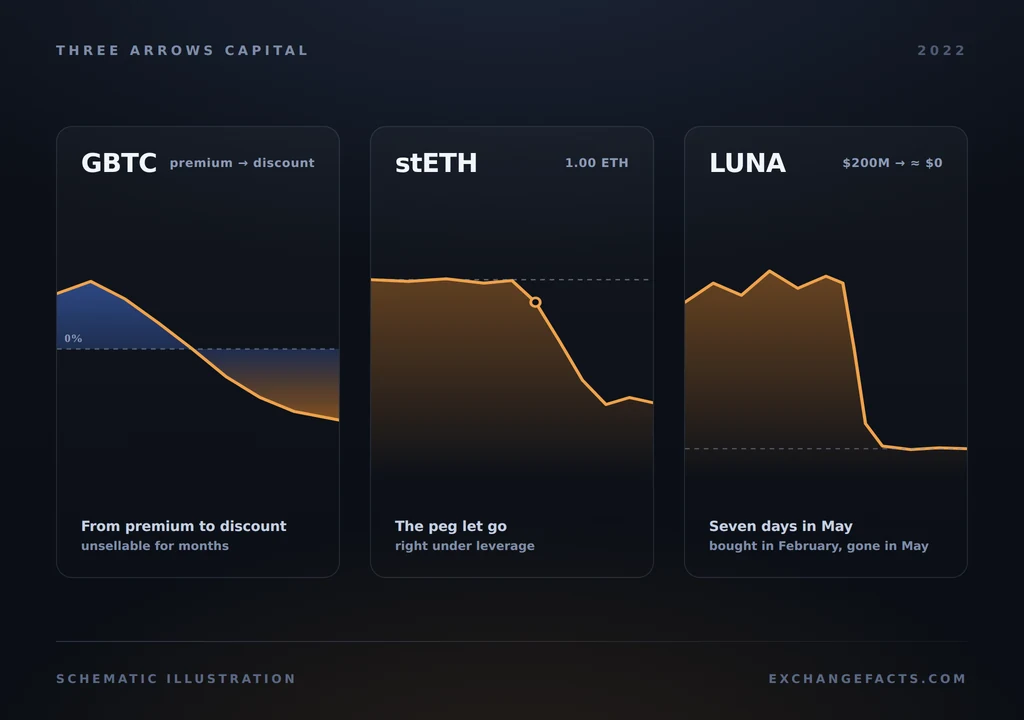
- GBTC: an enormous position in the Grayscale Bitcoin Trust, which fell from a premium to a deep discount and could not be sold for months.
- stETH: a leveraged bet that “staked ether” would stay pegged one-for-one to ether — right as that peg broke.
- LUNA: a bet of hundreds of millions on Do Kwon's Terra ecosystem — the coin that went to virtually zero in seven days in May 2022.
That LUNA bet was no accident. In Singapore, Zhu and Davies became friends with Do Kwon himself, and in February 2022 they bought $200 million worth of LUNA tokens. Three months later that position was worth almost nothing.
Each of those positions was big enough to hurt. Together, with leverage, they were lethal. And they all hung on the same belief: that it would not really go down.
May 2022: the fuse
The fuse was the collapse of Terra/Luna in May 2022 (see also our story on Do Kwon). When LUNA evaporated, 3AC lost hundreds of millions in one blow. But worse than the direct loss was what it exposed: the fund had no buffer. The supercycle machine had no brakes.
What followed was a quiet panic. 3AC tried to plug the holes by borrowing even more and shuffling positions, but the market kept sliding. The giant began to wobble — and everyone who had lent it money started calling.
The margin calls
In June 2022 the margin calls arrived: lenders demanding more collateral or repayment of loans. 3AC could not deliver. One lender after another realised it was impossible — the fund considered rock solid was insolvent.
Behind the scenes it was pure chaos. At one point 3AC tried to borrow another 5,000 bitcoin — some $125 million — from Genesis in order to pay off a different creditor: filling one hole by digging a new one. (Su Zhu disputes that account.) alleged Lenders complained that the founders had simply stopped replying to messages.
On 27 June 2022 a court in the British Virgin Islands ordered the liquidation of Three Arrows Capital. Days later, on 1 July, the fund sought protection from creditors in New York (Chapter 15). The bankruptcy filings showed a staggering figure: more than $3.5 billion in creditor claims. Total losses across 2021–2022 climbed above $4 billion — one of the largest trading losses in the history of any hedge fund anywhere.
The disappearance
And then the founders were gone. While liquidators from the advisory firm Teneo tried to salvage the wreckage, Su Zhu and Kyle Davies proved untraceable. The liquidators told the court the pair were not cooperating and that their whereabouts were unknown. They communicated only through lawyers and, occasionally, through cryptic posts on X.
Five weeks after the collapse they surfaced — not in a courtroom, but in an interview from an undisclosed location, in which they talked about moving to Dubai. Partly contrite, partly defensive: it was, they said, a systemic failure, easy credit that had magnified bad bets. What they did not do was hand in their passports or return to Singapore.
Much Wow
No detail captured the hubris quite like the yacht. Before the fall, Zhu and Davies had ordered a $50 million superyacht — an Italian Sanlorenzo with five decks, two fold-out terraces and a swimming pool. Davies wanted to display a collection of NFTs inside; one floor was to become a hydroponic garden, a wish of Zhu's wife, a biologist. They gave the vessel a name lifted straight from an internet meme: “Much Wow”, a nod to the Doge dog. Davies also briefly considered, he said later, buying an island.
The yacht was due to sail in July 2022. It never did: the shipyard cancelled the contract when the final payment failed to arrive, sold the vessel to another buyer, and the liquidators went after $30 million from that sale. The two men who thought they would sail the seas on other people's money never travelled a metre on it. “Much Wow” became the symbol of a fund that lived as though the bill would never come.
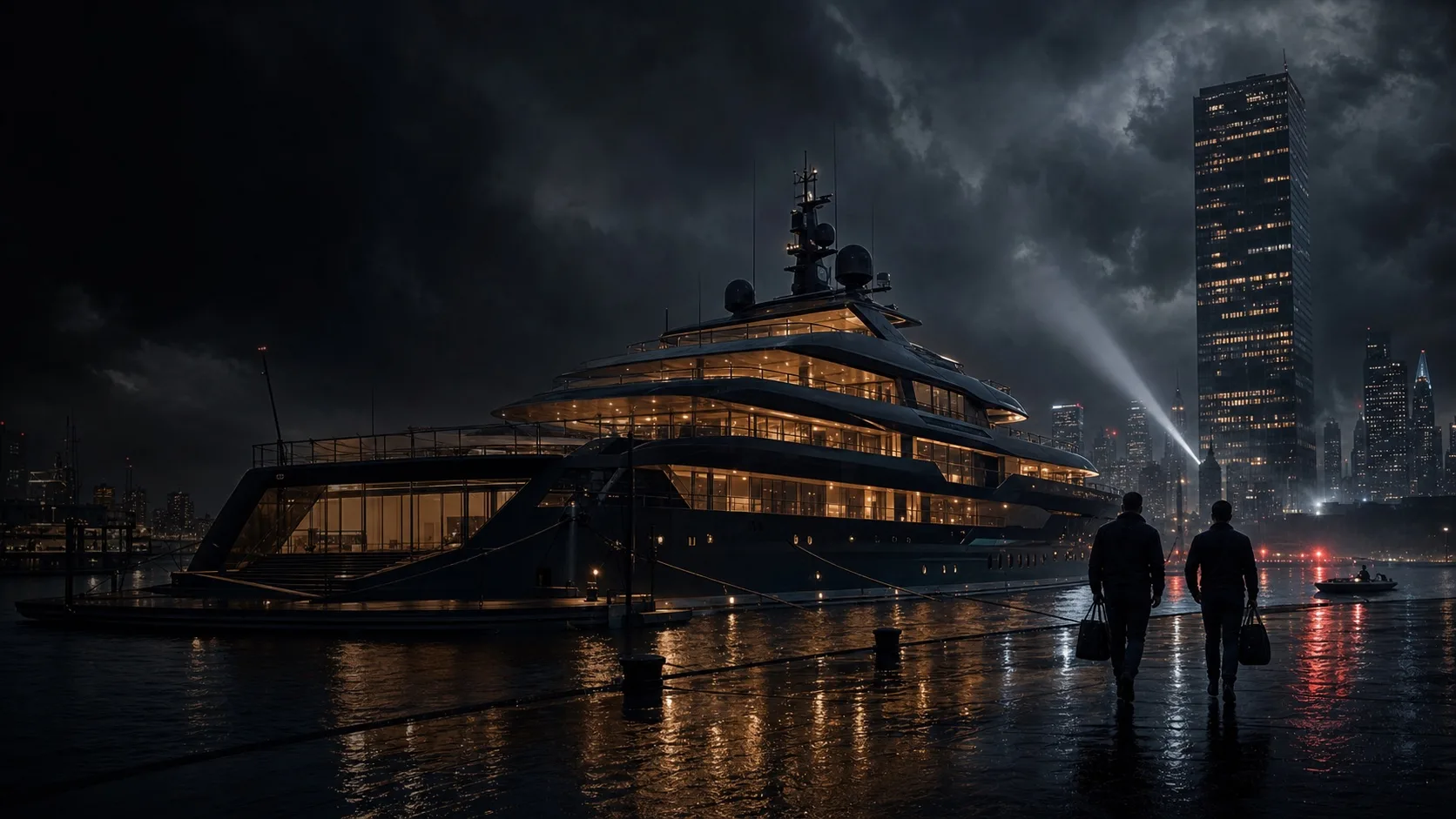
Very bankrupt, much wow.The yacht that never sailed became the symbol of 3AC's hubris
The domino
This is why 3AC belongs in this series, even though it was not an exchange. When the fund went down, it did not go down alone. The firms that had lent it money — often ordinary customers' money — got the bill:
- Voyager Digital, which had lent 3AC some $700 million, went bankrupt; the savings of millions of customers evaporated.
- Genesis and BlockFi suffered heavy losses — damage that rippled through to the fall of other players.
- Together with Celsius and Terra, 3AC was part of the cascade that wiped out some $2 trillion in crypto value in 2022.
The lesson is uncomfortable: people who had never heard of Three Arrows lost money because their exchange or lender had quietly lent their balances to this fund. In letters to the bankruptcy court, Voyager customers described what that did to their lives.
I wake up at night and pace the stairs, agonising over my own mistakes.A Voyager customer with $30,000 in savings, in a letter to the court proven
They went to Bali
And here this story parts ways with SBF's or Do Kwon's. While millions of small investors watched their savings evaporate and liquidators on two continents investigated, Kyle Davies got on a plane — to Bali. He painted in beach cafes, read Hemingway, travelled through Thailand and Malaysia, attended a Formula 1 race in Bahrain, and posed in Dubai with a tiger chained to a post. On a rooftop in Bali he took mushrooms with a group of crypto friends. Su Zhu learned to surf, played video games and laid out a permaculture farm in his garden in Singapore. Life as a crypto pariah, it turned out, was not so bad.
Neither showed a trace of regret. When a friend asked Davies whether he felt remorse, the answer was icily short:
Remorse for what?Kyle Davies, to The New York Times, June 2023 proven
Su Zhu insisted his lawyers had assured him that everything 3AC did was “whiter than white”. Asked whether Davies had moved to Bali because Indonesia has no extradition treaty with the US, he simply answered: “No. It's just a nice place.” One creditor compared the pair to Bernie Madoff in the press. And while they should have been appearing at a court hearing, one of them appeared, according to liquidator Russell Crumpler, to be “tweeting from a boat in Dubai”.
Even the mandatory liquidation meetings they treated with contempt. During a Zoom call in July 2022, both founders showed up with cameras and microphones off, and stayed silent while the liquidators put question after question to them. The liquidators' lawyer, Adam Goldberg, summed it up for the judge:
The founders' conduct shows they have something to hide.Adam Goldberg, lawyer for the liquidators proven
The manhunt and Changi
The reckoning came slowly, and partially. The liquidators hunted the founders worldwide and pursued $1.3 billion they were claiming back from them. But instead of cooperating, Zhu and Davies did something extraordinary: while on the run, they filed a claim of some $30 million through their own company against their own bankrupt fund — including a claim of some $66 million in the name of Davies's wife. The perpetrators joined the queue of their own victims.
And they planned a comeback. They launched a new exchange, OPNX — tellingly called “GTX” in internal pitch documents, the alphabetical successor to SBF's FTX (“I just thought it was very funny”, Zhu said) — where people could trade bankruptcy claims, including the claims against 3AC itself. Davies personally encouraged 3AC creditors to trade their claims there. Regulators in Dubai reprimanded the platform for operating without a licence; within a year it went under anyway.
And then, on 29 September 2023, Su Zhu ran out of road. At Changi airport in Singapore, while trying to leave the country, he was arrested. A court sentenced him to four months in prison for deliberately ignoring orders to cooperate with the liquidation. A similar committal order was issued against co-founder Kyle Davies.
Four months in prison — not for the billions that evaporated, but for refusing to help the liquidators who had to clear up the rubble.Singapore court ruling, September 2023 proven
Consider that bitter gap: the bankruptcy cost creditors billions, but the prison sentence was about disobeying the liquidator. That is how little grip the system had on what had actually happened.
What 3AC proved
Three Arrows was not an exchange and not a fraud in the classic sense — it was a bet that grew too big to take only itself down. And that is precisely why the lesson matters so much for anyone choosing where to trade: the danger is not only in your exchange, but in who your exchange lends your money to.
Every time a platform promises an attractive yield, that money goes somewhere. At Voyager and Celsius, some of it went to Three Arrows. When that fund fell over, the customers were no longer savers but creditors in a bankruptcy they had never seen coming. It is exactly the same mechanism that trapped the customers of Celsius and Gemini Earn.
That is why Europe's MiCAR law turns on two things that could have saved 3AC's victims: segregation of client money, so an exchange cannot simply lend your balance to a leveraged hedge fund, and transparency about what happens to your holdings. No law can ban a bet — but it can ban someone else from staking your money without you knowing.
The arrow that stands alone snaps easily, said the legend the fund was named after. What Su Zhu and Kyle Davies forgot is that three arrows breaking together take the whole quiver with them. So the question 3AC leaves behind is not whether your exchange is solid, but: who is it lending your money to behind your back?
Sources
Reconstruction of the collapse & ~$3bn AUM: Bloomberg, overview. BVI liquidation (27 June 2022), $3.5bn in claims: Fortune. The “Much Wow” superyacht: Decrypt, Bloomberg. Liquidators pursue $1.3bn: Benzinga. Su Zhu arrested at Changi + 4 months in prison (29 Sep 2023), Davies committal order, OPNX: TechCrunch, Fortune. Genesis largest creditor ($2.3bn) & the 5,000 BTC manoeuvre: Decrypt. Founders file ~$30M claim against their own fund (incl. ~$66M for wife): DailyCoin. Bali, “Remorse for what?”, “whiter than white”, cameras off on Zoom, $200M LUNA, yacht details, “boat in Dubai”: The New York Times.